I am a Postdoctoral Researcher at the Stanford Institute for Human-Centered AI, working with Sean Follmer and Hari Subramonyam. I received my Ph.D. from the Human-Computer Interaction Institute in Carnegie Mellon University's School of Computer Science, advised by Nik Martelaro. My research has been supported by Google, Toyota Research Institute, Adobe Research, Accenture Labs, NSF, and the Office of Naval Research.
My research designs interactive systems and models that make generative AI steerable. Today, people mostly steer AI with text prompts, describing what they want without seeing the range of what is possible. Instead, I build AI steering interfaces that turn a model's internal representations, such as its latent space and learned concepts, into controls people can see, explore, and directly manipulate. I study this through the lens of design, where goals are often ill-defined, take shape through exploration, and are hard to put into words.
Several questions I am exploring include:
- Latent Manipulation. What would direct manipulation look like for the latent spaces of AI models, and can the same operations generalize across different models and modalities?
- Steerable Models. How can we train models whose internal representations align with the abstractions people already use to think and create?
- Generative User Interfaces. When AI can generate interfaces in real time, how should they adapt to people's tasks, goals, and expertise?
- Steering Agents. When people delegate tasks to AI agents, how can they verify the agents' work, and when should agents surface decision points for human judgment?
Publications
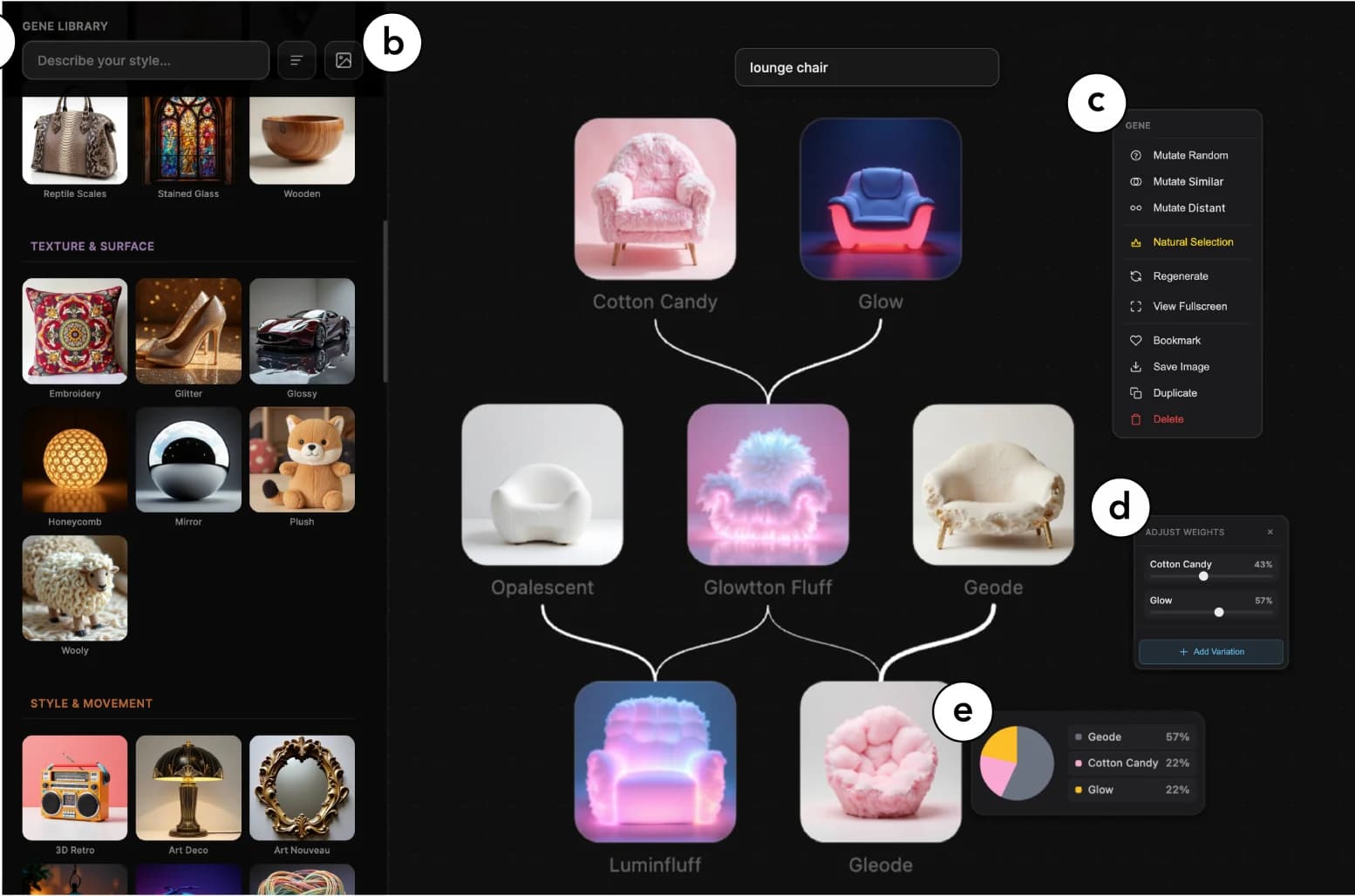
GENErator: Supporting Design Style Exploration with Generative AI through Genetic Mixing
GENErator lets designers explore combinations of AI image styles by mixing them like genes.
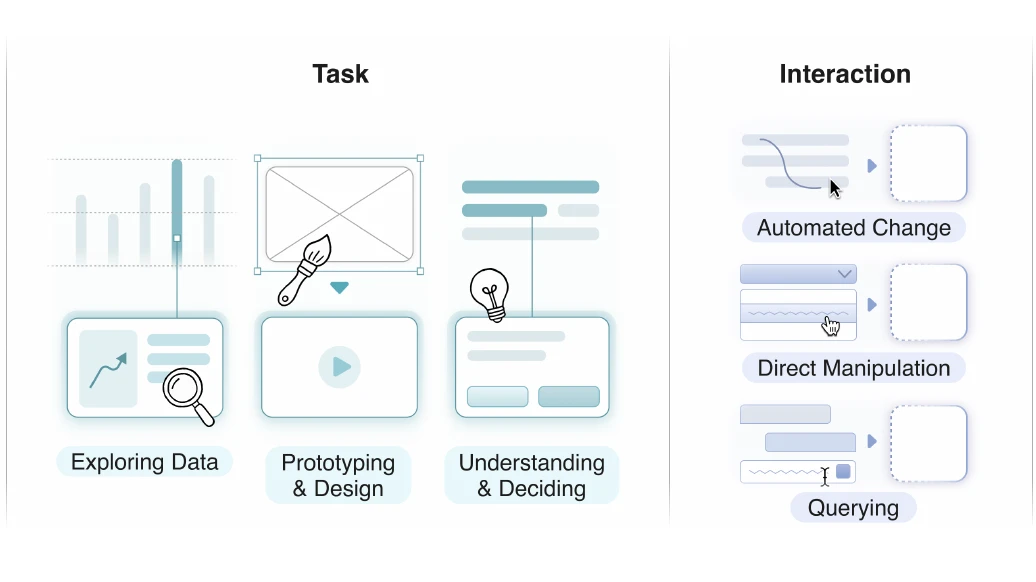
Generative User Interfaces: A Definition and Design Space
Generative User Interfaces defines GenUI and maps how systems vary across user, task, interaction, and technology.

Tracing Creativity: A Design Space For Creative Activity Traces in HCI
ACM Conference on Human Factors in Computing Systems (CHI), 2026
Tracing Creativity reviews 133 creativity systems to map how traces of creative activity are captured and used.

BioSpark: Beyond Analogical Inspiration to LLM-augmented Transfer
ACM Conference on Human Factors in Computing Systems (CHI), 2025
BioSpark helps designers find inspiration in biology and transfer it to their own design problems.

NoTeeline: Supporting Real-Time, Personalized Notetaking with LLM-Enhanced Micronotes
ACM Conference on Intelligent User Interfaces (IUI), 2025
NoTeeline lets people write quick keypoints while watching educational videos, then expands them into full notes.
VideoMap: Supporting Video Exploration, Brainstorming, and Prototyping in the Latent Space
ACM Creativity and Cognition (C&C), 2024
NeurIPS Machine Learning for Creativity and Design, 2022
VideoMap helps video editors organize footage, find transitions, and prototype rough cuts by exploring video frames on a visual map.
SeqDynamics: Visual Analytics for Evaluating Online Problem-solving Dynamics
Eurographics Conference on Visualization (EuroVis), 2020
SeqDynamics helps instructors see how students solve problems over time through interactive visual analytics.
ARchitect: Building Interactive Virtual Experiences from Physical Affordances by Bringing Human-in-the-Loop
ACM Conference on Human Factors in Computing Systems (CHI), 2020
ARchitect lets an assistant map physical objects to virtual ones in augmented reality, so a VR player can interact with their real surroundings.
Learning to Film from Professional Human Motion Videos
IEEE/CVF Conference on Computer Vision and Pattern Recognition (CVPR), 2019
Learning to Film teaches a drone to film automatically by learning from cinematic drone videos shot by professionals.