


Inkspire: Supporting Design Exploration with Generative AI through Analogical Sketching
Inkspire helps product designers explore ideas by sketching with AI, using analogies for inspiration and AI designs turned back into sketches.
Summary
With recent advancements in the capabilities of Text-to-Image (T2I) AI models, product designers have begun experimenting with them in their work. However, T2I models struggle to interpret abstract language and the current user experience of T2I tools can induce design fixation rather than a more iterative, exploratory process. To address these challenges, we developed Inkspire, a sketch-driven tool that supports designers in prototyping product design concepts with analogical inspirations and a complete sketch-to-design-to-sketch feedback loop. To inform the design of Inkspire, we conducted an exchange session with designers and distilled design goals for improving T2I interactions. In a within-subjects study comparing Inkspire to ControlNet, we found that Inkspire supported designers with more inspiration and exploration of design ideas, and improved aspects of the co-creative process by allowing designers to effectively grasp the current state of the AI to guide it towards novel design intentions.
Video
Background
Text-to-Image (T2I) models can now generate realistic images from text, and product designers have started to try them in their work. However, recent works have found that designers using generative AI can become fixated and explore fewer novel ideas. For example, a designer may write a prompt, generate, change a few words, and generate again, ending up with a final prompt that is conceptually close to the first one.
To understand how professional designers experience this, we held a day-long exchange session with seven product designers at a large automotive company. From our discussions, they found prompting to be an unnatural way to design compared to sketching, T2I models to give generic results for abstract concepts (e.g., a "protective" car), and generated designs to look "too complete" to build on.
Method
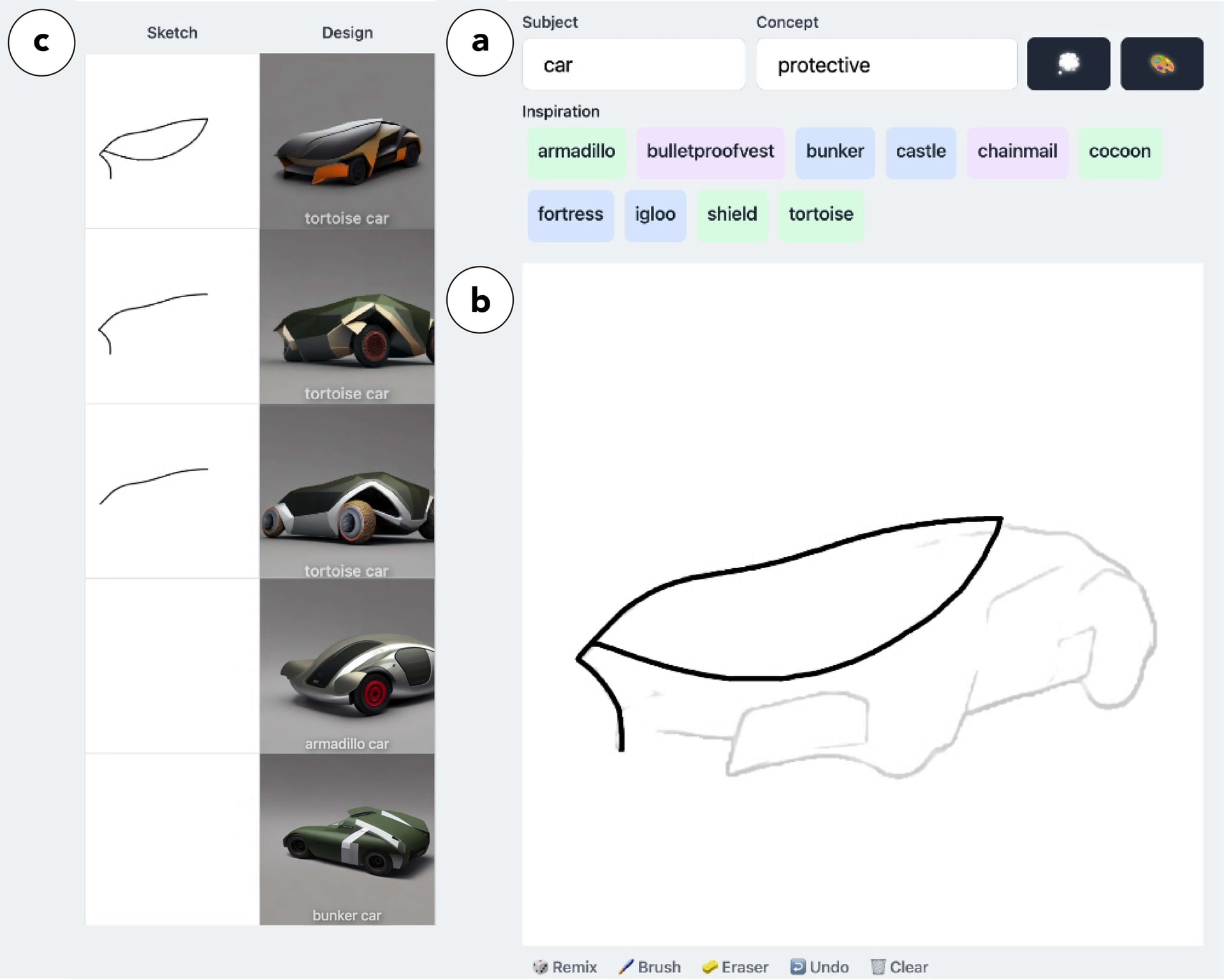
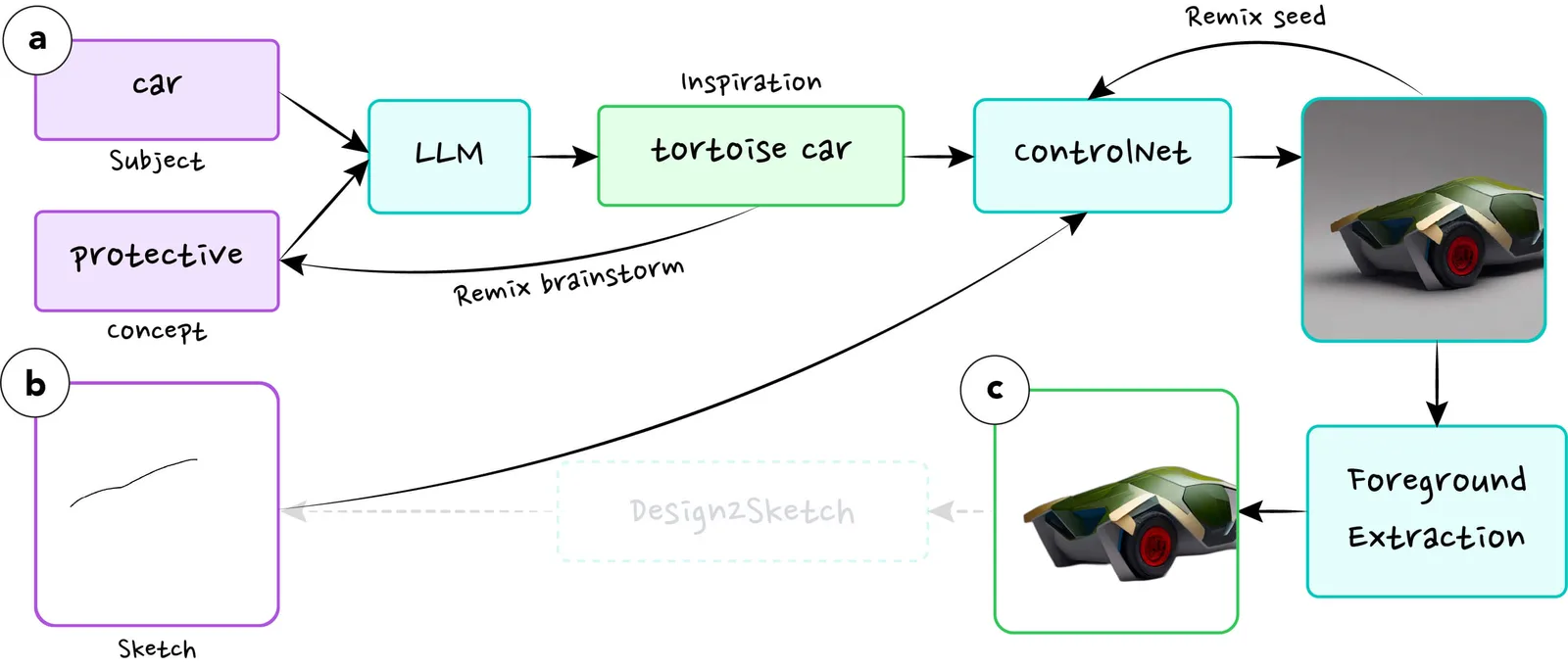
We present Inkspire, a proof-of-concept tool that lets designers prototype product design concepts by sketching with T2I models, using analogies for inspiration and a feedback loop that turns AI designs back into sketches. Inkspire consists of two primary components: Sketch2Design, which generates designs from sketches and analogies, and Design2Sketch, which converts designs into lower-fidelity sketch scaffolding.
Design Goals
Based on the exchange session, we designed Inkspire with three design goals:
- Sketching as a natural method of interaction. Let designers guide the AI through sketching, starting from as little as a single line or silhouette.
- Visually-concrete inspirations. Help designers visualize abstract design themes through concrete analogical inspirations.
- Complete the feedback loop. Turn AI designs back into abstractions (sketches), so designers can keep iterating on them.
Sketch2Design
In Sketch2Design, the designer first enters a subject (e.g., car) and an abstract concept (e.g., protective) in the Analogical Panel. To brainstorm analogical inspirations, we prompt GPT-4 in two steps: first to describe the key design principles of the subject, then to suggest visually-concrete objects from nature, architecture, or fashion that convey the concept (e.g., tortoise, armadillo, armor). The designer can then sketch on the Sketching Panel, starting from a single stroke. Each time a stroke is drawn, we use ControlNet to guide Stable Diffusion with the sketch and the selected inspiration to generate a new design. Since ControlNet struggles with incomplete sketches, we adapted it with a dynamic guidance scale that starts low and increases as more strokes are added, so the designs follow the sketch more closely as it becomes more complete. The Remix tool generates variations from the same inspiration and sketch.
Design2Sketch
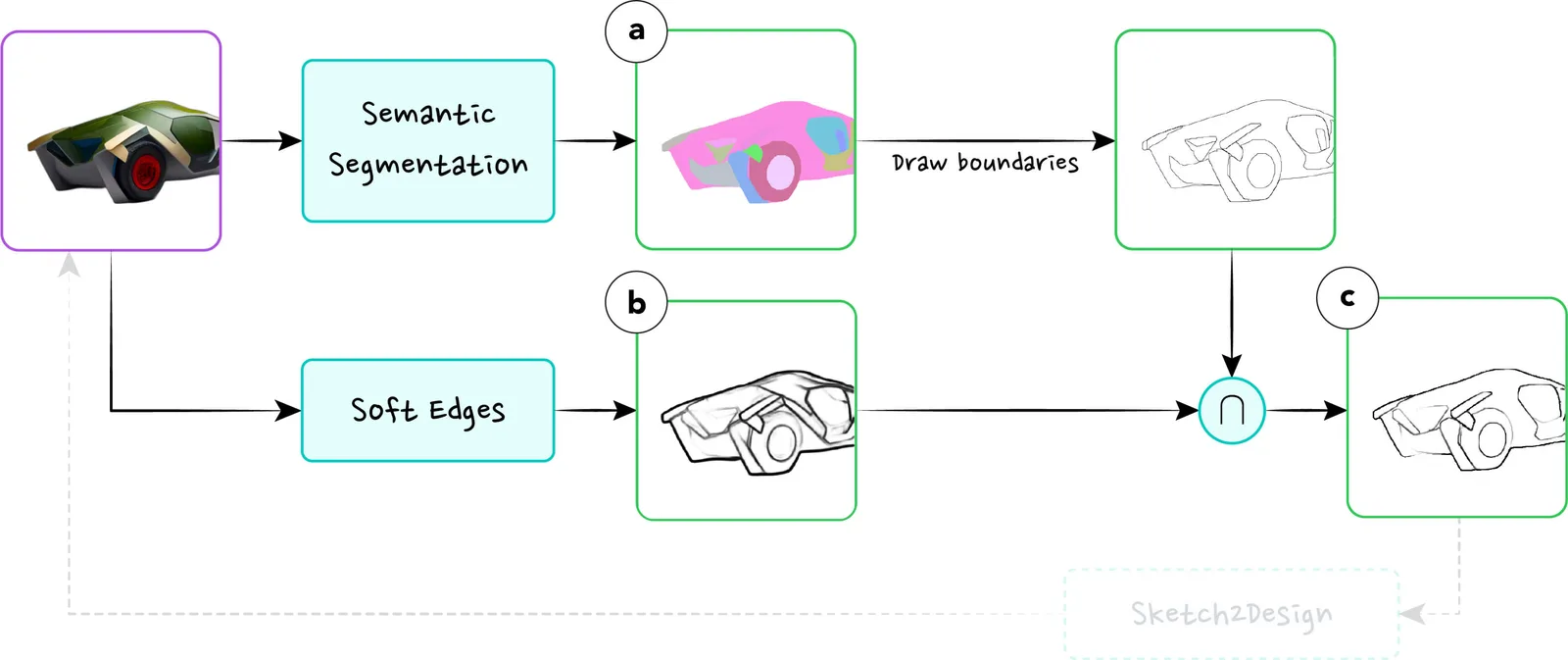
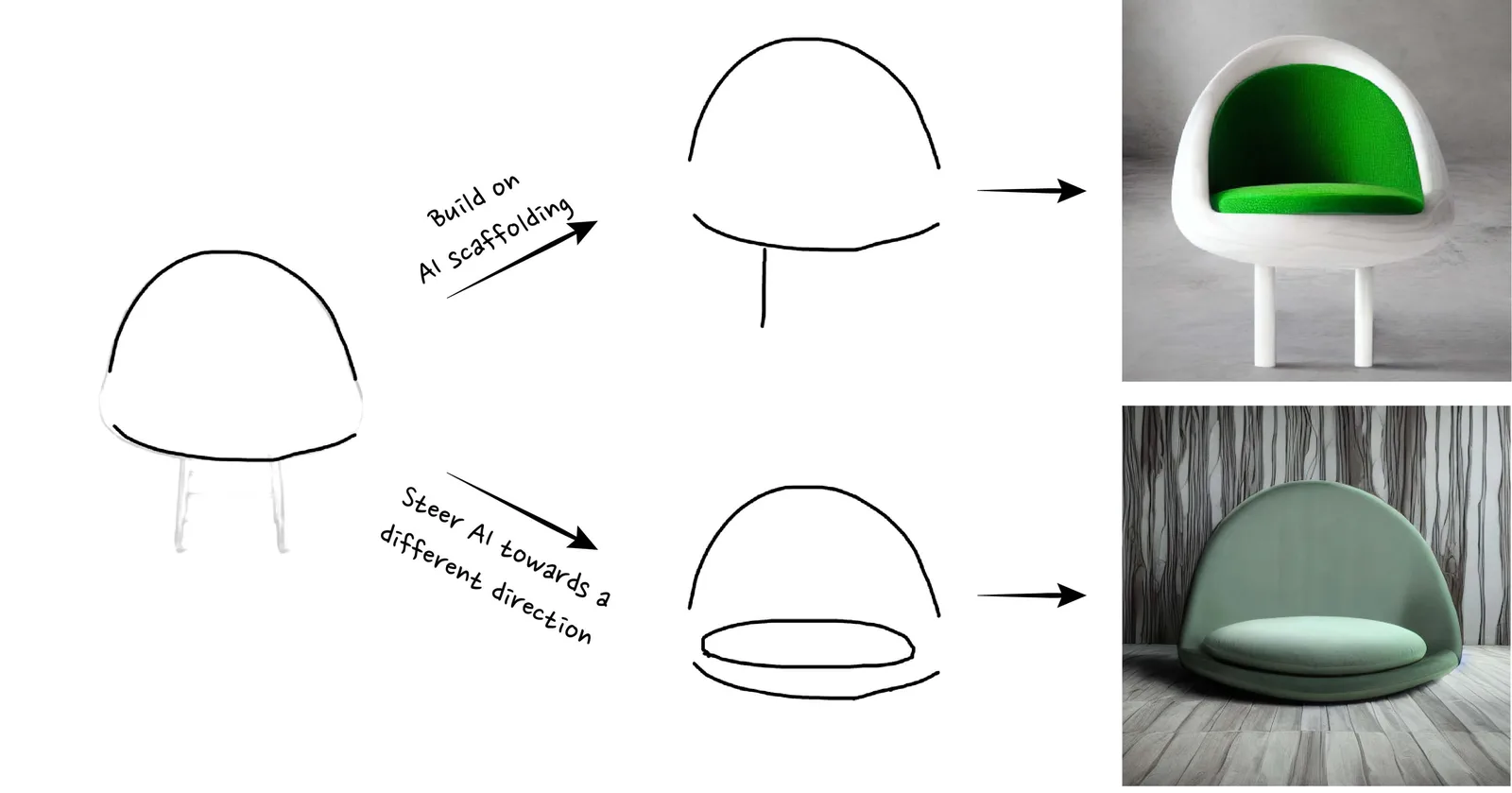
Design2Sketch abstracts each generated design into a lower-fidelity sketch, which we call a scaffolding. The scaffolding is shown as a transparent layer under the designer's canvas and updates as they sketch, so the designer can take inspiration from parts of the AI design without being fixated on a photorealistic render.
We first tested existing methods for converting images to sketches, including edge detection, manga line extraction, and a neural network trained on pairs of sketches and images. However, they added lines from the design's texture, lost key lines, or added shading. Instead, we combine semantic segmentation and edge extraction. We draw the boundaries between regions of the segmentation map and take their pixel-wise intersection with soft edges extracted from the design. This keeps the sketch-like look of the soft edges while keeping only the key structural lines.

With the scaffolding, the designer can either trace it to build on the AI design or draw something different to steer the AI in another direction.
User Study
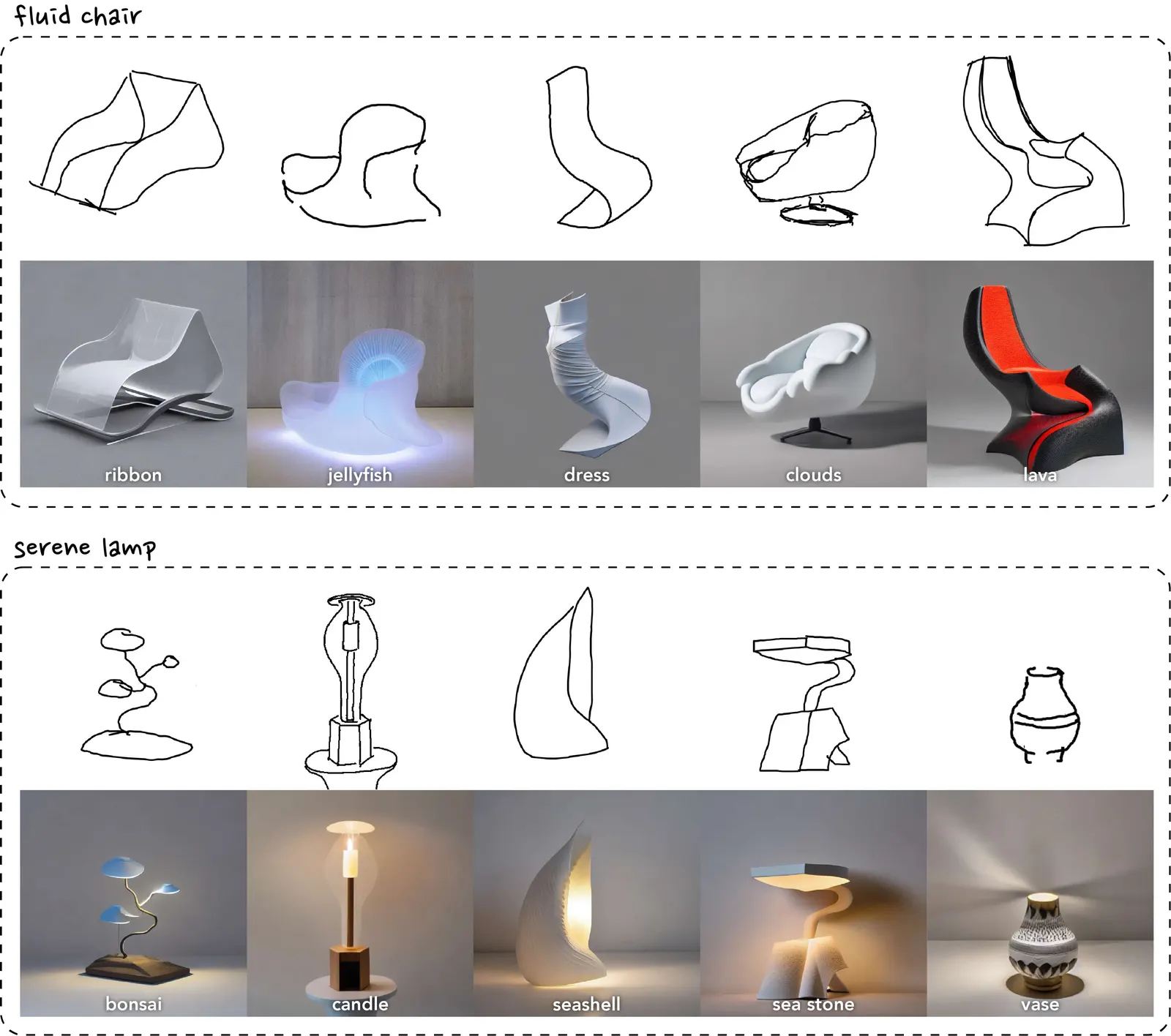
We conducted a within-subjects study with 12 participants, six professional product designers and six novices with moderate drawing experience. Each participant did one design task with Inkspire and another with a baseline ControlNet tool, which has a prompt box and a sketching canvas but no analogical inspirations, scaffolding, or per-stroke generation. The tasks were a serene lamp and a fluid chair, and we counterbalanced the order of the tools and the tasks. After each task, participants rated creativity support (Creativity Support Index), human-AI collaboration, and their sketching experience on 7-point Likert scales, and we logged their interactions.
Generally, participants rated Inkspire significantly higher than the baseline on inspiration and exploration, and on controllability, communication, partnership, and attribution in working with the AI. The other creativity and collaboration measures did not differ significantly. Participants also rated sketching with Inkspire as significantly more inexpensive and abstract, and their overall experience with Inkspire as significantly better. They rated the quality of their final designs higher with Inkspire, though not significantly.
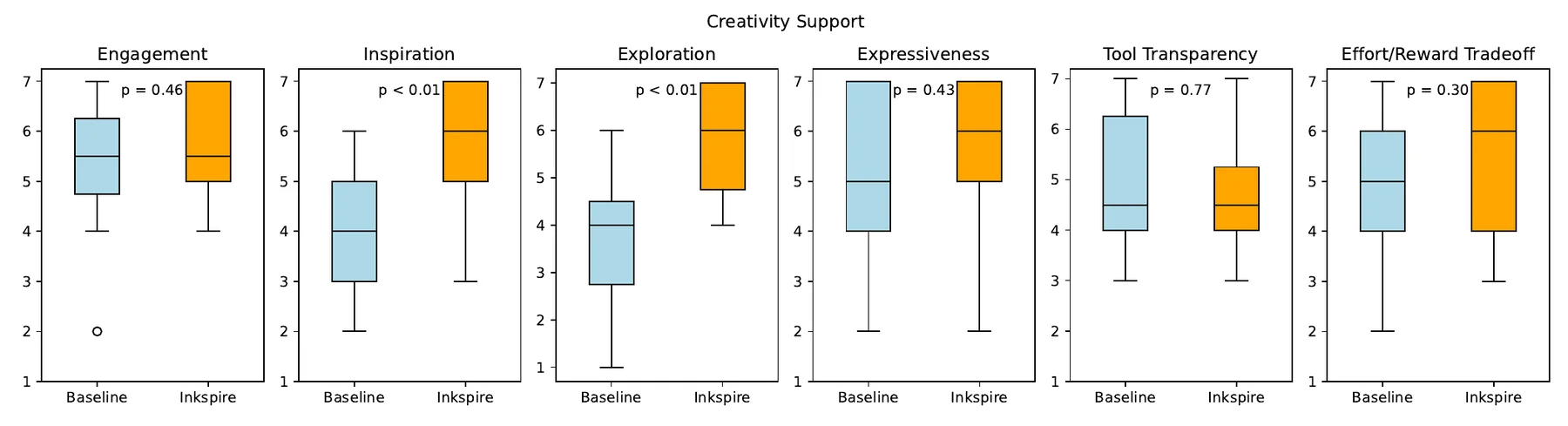
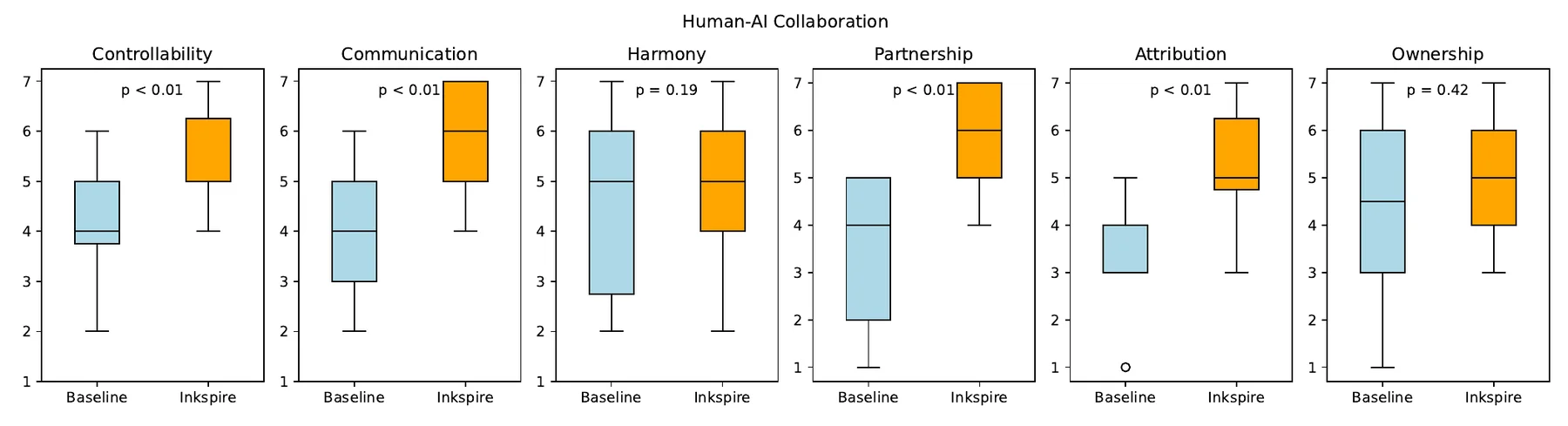
The interaction logs also show different ways of working with the AI. With the baseline, participants often drew a full sketch before generating and then made small edits to the same prompt. With Inkspire, participants tried several analogical inspirations at the start, then sketched a few strokes at a time and built on the scaffolding, and their prompts were less similar to each other. Many participants also said the scaffolding helped them see what the AI was currently doing and decide where to sketch next.
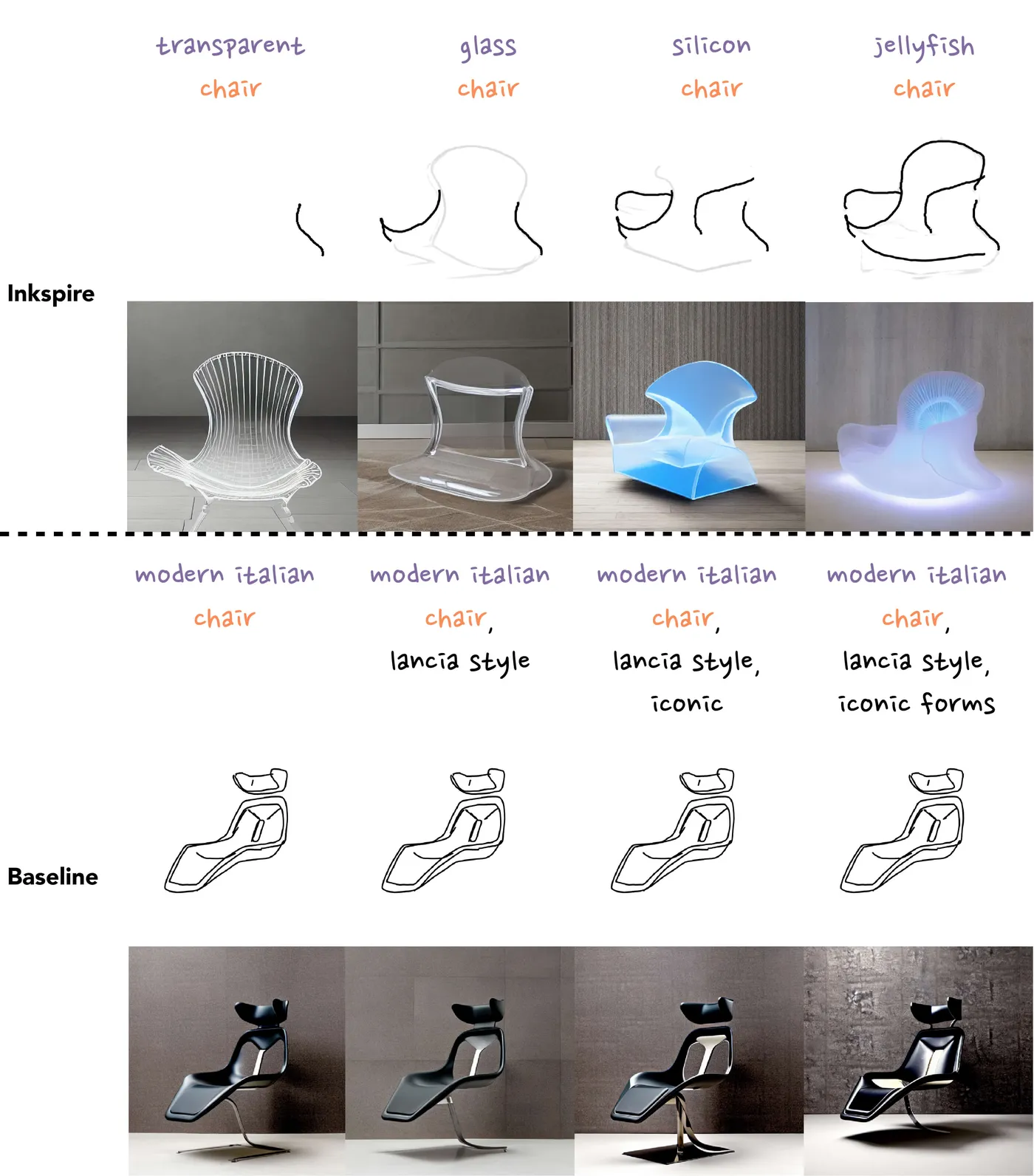
Below are example designs created by participants with Inkspire.
Acknowledgments
This work was supported by funding from the Toyota Research Institute and the Office of Naval Research. We would like to thank Matthew Klenk for valuable conversations and guidance on the research, and friends in the Augmented Design Capability Studio for valuable feedback on our system and paper.
Citation
@inproceedings{lin2025inkspire,
  author    = {Lin, David Chuan-En and Kang, Hyeonsu B. and Martelaro, Nikolas and Kittur, Aniket and Chen, Yan-Ying and Hong, Matthew K.},
  title     = {Inkspire: Supporting Design Exploration with Generative AI through Analogical Sketching},
  booktitle = {Proceedings of the 2025 CHI Conference on Human Factors in Computing Systems},
  series    = {CHI '25},
  year      = {2025},
  articleno = {427},
  numpages  = {18},
  publisher = {Association for Computing Machinery},
  address   = {New York, NY, USA},
  doi       = {10.1145/3706598.3713397},
  url       = {https://doi.org/10.1145/3706598.3713397},
  location  = {Yokohama, Japan}
}